
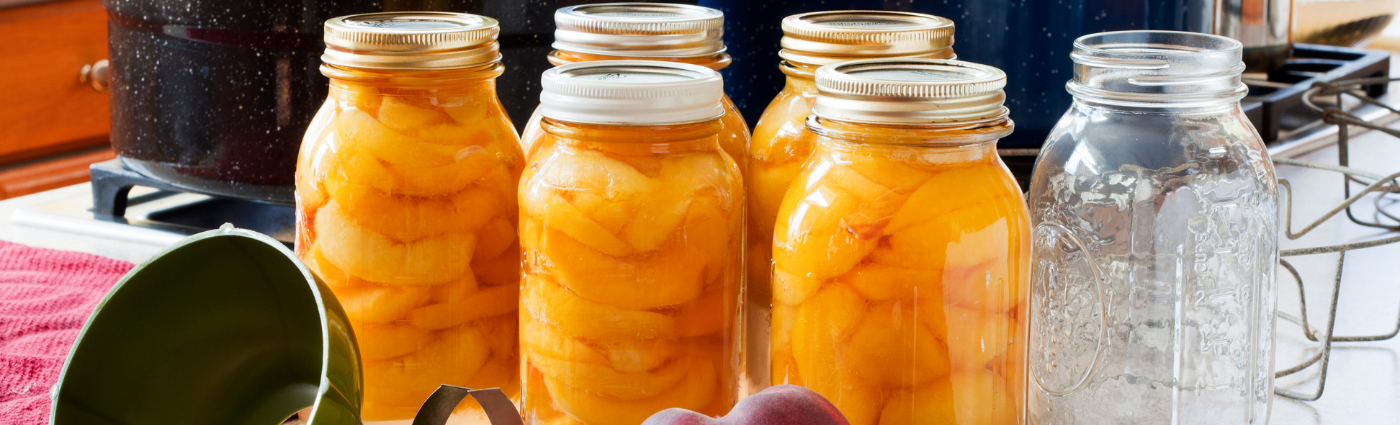

General directions for canning fruit
Canning is a method of preserving food that involves heating filled jars of food to a specified temperature for a specified time. This heating is known as "processing" and is essential for the food safety of all home-canned foods. Processing destroys microorganisms that enter the jar upon filling and allows air to be vented from the jar to create an airtight vacuum seal as the product cools.
Basic steps:
1. Before beginning, review the following information and assemble all equipment and ingredients.
2. Visually inspect canning jars for nicks, cracks, uneven rims or sharp edges that may prevent sealing or cause jars to break. Screw bands may be reused. Check to ensure screw bands show no rust, are in good condition and fit properly on jars. Discard any jars and screw bands that are not in good condition. Use new metal lids each time to ensure a vacuum seal. Wash jars, screw bands and lids in hot soapy water. Rinse well.
3. Sterilize jars just before use. To sterilize jars, place upright into the rack in a boiling water canner. Cover with room temperature water. Cover canner with lid. Place over high heat and bring to a boil; boil rapidly for 15 minutes or as required (see Altitudes in Alberta). Raise rack holding jars and hook handles on sides of the canner. Leave water-filled jars in canner until ready to fill with fruit. Prepare metal lids according to manufacturer’s instructions; leave in hot water until ready to use. Screw bands do not need to be sterilized.
4. Prepare firm ripe fruit according to directions found in Canning Specific Fruits.
5. Drain one jar at a time into the sink and fill immediately with prepared fruit using either a Hot Pack or Raw Pack. The Hot Pack allows more fruit to be packed into jars and helps to maintain the colour and texture of the fruit.
Hot Pack: Simmer the fruit in syrup (see Canning Liquids below) in a saucepan for 5 minutes. Fill jars with hot fruit; cover with boiling syrup, leaving 1/2 inch headspace. Headspace is the space at the top of the jar between the underside of the lid and the top of the food or liquid.
Raw Pack: Pour boiling syrup over raw fruit in jars, leaving 1/2 inch headspace.
6. Remove air bubbles by sliding a non-metallic utensil, such as a narrow rubber spatula or plastic knife, between the jar and fruit. After removing air bubbles, add additional syrup, if required, to maintain 1/2 inch headspace. Wipe jar rim thoroughly with a clean damp cloth.
7. Center lid on jar. Apply screw band just until “fingertip tight”. Do not overtighten. “Fingertip tight” allows some give between the lid and jar and allows air to escape during processing. This creates a vacuum seal as the product cools.
8. Place the filled jar into the raised canner rack. Repeat process with remaining jars. When all jars are filled or the canner is full, lower rack into hot water. Be sure jars are covered by at least 1 inch of water; add boiling water, if required. Place lid on the canner and turn heat to high.
9. When water returns to a full rolling boil, begin counting processing time (see Canning Specific Fruits). Reduce heat to maintain a gentle and steady boil for the required time. Turn off heat and remove canner lid. Allow boil to subside, then lift jars without tilting and place them upright on a rack, dry towel or a cutting board to cool in a draft-free place. Do not retighten screw bands or turn jars upside down as seals may be broken. Allow jars to cool undisturbed for 24 hours.
10. After cooling, check jars for vacuum seal by pressing on the center of each lid. Sealed lids curve downward and do not move. Refrigerate any unsealed jars and use the fruit within one week, or freeze or reprocess within 24 hours. Reprocessing fruit is not recommended as it gives a significantly overcooked product. However, if reprocessing is desired, empty jars, reserving fruit and syrup. Repeat all steps. If a sealed jar becomes unsealed after some time in storage, this indicates spoilage from microbial growth. Discard the contents of the jar.
11. To store sealed jars, wipe with a clean damp cloth. Remove, wash and dry screw bands. Store separately or replace loosely on jars, as desired. Label jars and store in a cool dark place. As a guideline, use home canned foods within one year.
Canning Liquids:
Sugar syrups, fruit juice or plain water can all be used as the liquid when canning fruit. A sugar syrup is the recommended liquid as the sugar helps retain the best flavour, colour and texture of fruit.
- Sugar syrups - To prepare syrup, combine sugar and water. Bring to a boil, stirring occasionally to dissolve sugar. Allow 1 – 1 1/2 cups syrup for each quart (litre) jar. Syrup may be prepared and refrigerated for up to three days before use. Return syrup to a boil to pour over fruit in jars.Sugar Substitutions: Up to one-half of the sugar may be replaced with an equal amount of mild-flavoured honey. Up to one-quarter of the sugar may be replaced by an equal amount of light corn syrup. Artificial sweeteners that are heat stable, such as Splenda and Original Formula Sugar Twin, may be used to sweeten the water to taste. All other artificial sweeteners should be added to fruit at serving time.
- Fruit juice - Fruit juice, such as apple, white grape juice or pineapple juice, may be used as a canning liquid. Fruit juice may be used full strength or diluted half-and-half with water, if desired. The fruit's own juice may also be used in place of a sugar syrup. To obtain juice from the fruit, combine and bring to a boil equal amounts of fruit and water. Simmer and cook until soft, mashing occasionally while cooking; strain. Refrigerate prepared juice for up to 3 days or freeze for later use. Bring to a boil to pour over fruit in jars.
- Water - Boiling water may be used as a canning liquid, however, the fruit will not be as flavourful, plump or colourful as fruit canned with a sugar syrup. If desired, artificial sweeteners may be added to the fruit at serving time.
- Preventing discolouration - Some fruits, such as apples, apricots, nectarines, peaches and pears, darken after they are cut or peeled. To minimize darkening as fruit is being prepared for canning, it may be placed in a colour protecting solution made of one of the following:
- 1 tbsp salt in 8 cups cold water. Hold fruit in solution for a maximum of 20 minutes to ensure salt flavour is not transferred to fruit.
- 2 tbsp Fruit Fresh® in 4 cups cold water.
- 1 tsp ascorbic acid crystals (vitamin C) in 4 cups cold water or nine 500 mg finely crushed vitamin C tablets to 4 cups cold water.
- 1/4 cup bottled lemon juice in 4 cups cold water. Lemon juice is not as effective as the above methods and may contribute an undesirable flavour.
Note:
ATCO Blue Flame Kitchen information and recommendations contained in this publication have been researched and are in accordance with current guidelines published by Bernardin Ltd. and the Cooperative Extension Service, University of Georgia. We acknowledge their assistance. The Bernardin Ltd. "Guide to Home Preserving" is available at retail outlets in Alberta.
The methods and procedures outlined in this publication are recognized as safe. Many factors over which we have no control may cause spoilage. ATCO Blue Flame Kitchen assumes no responsibility for any failures or spoilage that may occur.